What tenants settle on their own no longer reaches the office.
Every tenant finds their answer, and the team only receives what needs it: qualified, documented, prioritised.
Monday, 8:30 a.m.
Forty e-mails, twelve voicemails, a leak reported on Friday evening, someone on the phone who doesn't understand their service-charge statement. And the appointment to take on a new property, in 30 minutes.
Most calls are about information you already have: a balance, a lease clause, a repair in progress.
That time is lost margin. The problem is not the teams' commitment: it's the time absorbed by what could be settled without them.
Every tenant goes part of the way.
A platform where tenants and managers meet: the tenant gets their answer, the manager only receives what needs them.
Fewer requests
The assistant answers at any hour, from the file's data.
Qualified requests
Diagnosis, photos, equipment: nothing to piece together.
Rent followed up
Matches suggested, reminders prepared in batches.
No re-keying
From rent call to service-charge settlement.
Fewer calls, better requests.
- Find out. Lease, balance, charges, rights: the assistant answers at any hour, from the file's data.
- Act. Solve a problem, enter meter readings, sign: no call, no appointment.
- Pass on. What belongs to the manager arrives diagnosed, documented, prioritised.
A real example: a tenant asks who pays for boiler maintenance; the assistant reads the clause in their lease and answers. One question fewer for the team. The assistant changes nothing on its own: it prepares, the tenant confirms.
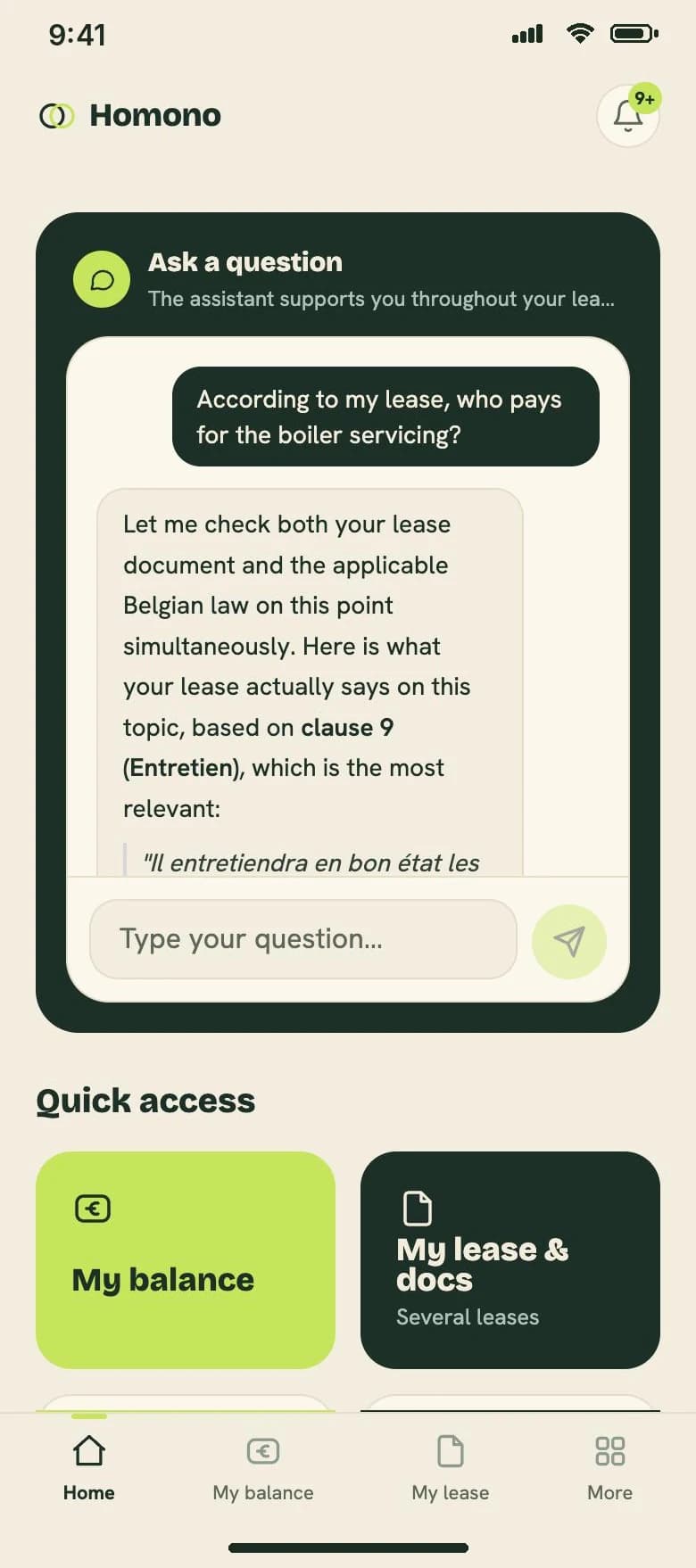
The team's time, where it counts.
Know.
The whole portfolio, in plain language: is the money coming in, are the units occupied, what's next for me.
Anticipate.
Arrears, deadlines, indexations: what needs attention is flagged before it becomes urgent.
Decide.
Files ready for a decision: diagnosis, photos and equipment attached.
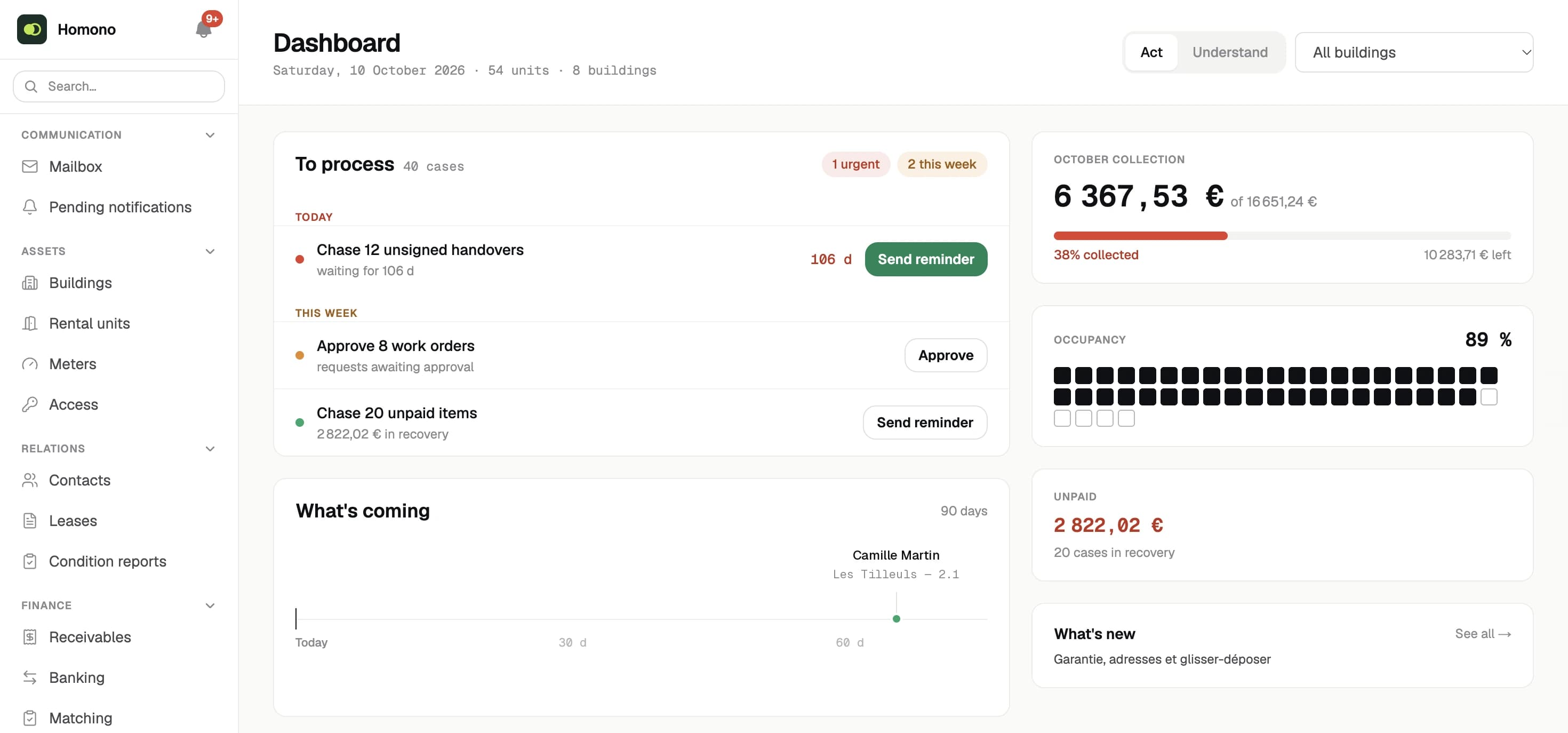
The whole rental cycle, from move-in to the returned deposit. The tool prepares, people decide.
A view for every party.
Tenant
- Their lease, their documents
- Their balance, their payments
- Their charges, their meters
- Repairs, messages
- Equipment, user manuals
- Their insurance, their access
Property manager
- The whole portfolio, every lease
- Collections, reminders
- Accounting, statements
- Indexations, deposits
- Repair scheduling
- Exchanges with every party
Owner
- Their properties
- Their income
- Their expenses
- Their statements
- Repairs
- Their taxes
Contractor
- Their jobs
- Their schedule
- Their services
Admin
- The organisation's workspace
- Integrations
- Accounts and their roles
- The contract with Homono
Five views of the same data, each limited to its scope: the separation is enforced by the database itself, not just by the screen. One account can hold several roles.
Lower costs, better returns.
Fewer incoming calls.
The assistant answers at any hour about the lease, the balance, the charges, the rights.
Requests ready to handle.
Diagnosis, photos and equipment attached: nothing to piece together, nothing to chase.
Every euro in the right place.
Payment matching suggested, confirmed in one click; reminders and payment plans prepared.
Decisions based on facts.
Vacancy, deadlines and indexations visible, traceable activity, everyday indicators.
These levers are measured on your own figures during the pilot: we promise no savings amount beforehand.
AI is coming to property management. With Homono, you're already there.
From software to conversation
No more searching through menus: you ask the question.
From data entry to intelligence
Data goes in once; the tool links it, explains it and prepares what's next.
From reactive to proactive
What needs attention is flagged before it becomes urgent.
From closed to open
Your data and your processes stay yours, whatever tomorrow's model.
An MCP server, and each organisation choosing its AI model.
Models change; your data and your processes stay. The AI prepares, people decide.
This is not a mock-up.
A real portfolio is managed in Homono every day: assets and equipment, leases and inventories, receivables, bank, matching, payment plans, repairs, accounting, tenant app.
- 8
- buildings managed
- 54
- units, 46 leases
- 3,000+
- bank transactions
- 6
- profiles, one tool
- Free for tenants
- Already in six languages
- Data stored in Europe
A three-month pilot, measured on your figures.
- 1
Scope
The scope and indicators: incoming requests, handling time, collection. A baseline measured before set-up.
- 2
Set up
Import of existing data, configuration, training, tenant onboarding. Fixed fee, fixed date.
- 3
Use
Three months in real conditions, supported by our teams.
- 4
Decide
A review in figures against these indicators, then the choice: extend, adjust or stop.
Next step: a meeting to scope the pilot.